What's Actually in the Air When the Candle Goes Out: A Living Room Air-Quality Investigation
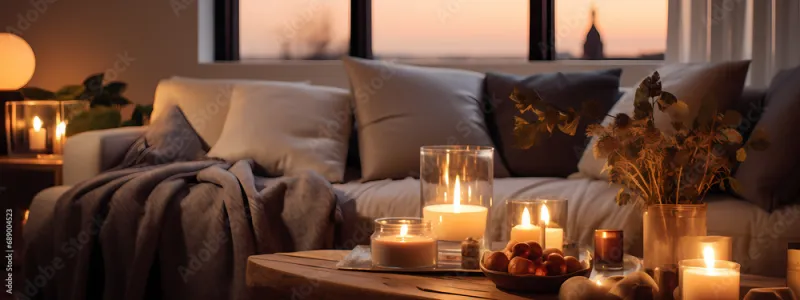
Photo: lit soy candle on living room table cozy evening, via as2.ftcdn.net
There's a particular kind of American evening that involves dimmed lights, a soy candle with a kraft-paper label promising 'non-toxic' and 'clean-burning,' and the vague belief that because it says natural on the jar, it must be harmless.
I believed it too. Then I borrowed a consumer-grade air quality monitor, lined up every scented product in my house, and spent a week turning my living room into a very small, very flammable science lab. What I found should probably come with its own warning label.
The Setup: One Monitor, Six Products, Zero Airflow
The rules were simple. One PM2.5 sensor (that's fine particulate matter — the stuff that lodges deep in your lungs), one VOC meter (volatile organic compounds — the gases that become 'smell'), and a typical living room with the HVAC set to auto.
Baseline readings first: with nothing burning, my living room sat at a comfortable 4 micrograms per cubic meter of PM2.5 and low VOCs. Then the experiments began.
Experiment One: The 'Clean' Soy Candle
The candle in question cost $34, was marketed as non-toxic, and listed a soy wax blend with phthalate-free fragrance oil. Sounds great. But here's what the label doesn't explain: soy wax is the fuel, not the fragrance. Nearly every scented candle — soy, beeswax, paraffin, doesn't matter — works by vaporizing fragrance oil into the air. You are, essentially, aerosolizing perfume on purpose.
Thirty minutes after lighting, my PM2.5 reading hit 42 µg/m³. For context, the EPA's 24-hour health standard for outdoor air is 35. My living room, briefly, had worse air quality than a bad day in Los Angeles.
An indoor air chemist I spoke with put it plainly: 'When you burn anything indoors, you're running an unvented combustion appliance. The wick doesn't care what the wax is made of — combustion produces particles.' The soy part matters mainly for the soot on the jar, not the soot in your lungs.
Experiment Two: The Plug-In and the Diffuser
Plug-in diffusers were the quiet overachievers. They don't burn anything, so PM2.5 stayed low — but VOCs nearly tripled within an hour. Those VOCs are largely terpenes and synthetic fragrance compounds, some of which react with indoor ozone to form formaldehyde and other byproducts. Your nose reads 'cozy vanilla' as chemistry, because it is.
Ultrasonic essential oil diffusers performed similarly: low particles, elevated VOCs, and one surprise. Lavender oil, diffused for an hour in a closed bedroom, pushed VOC readings into a range that made the monitor's little screen flash a warning color I'd never seen before.
So Is Every Candle a Scam?
No — and this is where the story gets more interesting than 'everything is poison.' Dose makes the poison, and ventilation makes the difference.
The same candle that pushed my living room to unhealthy readings barely moved the numbers in a room with a cracked window and a box fan. The problem isn't the product. It's the airtight, weather-stripped, energy-efficient American home that never gets a cross-breeze from November to April.
Modern homes are built tight to save energy — a genuinely good thing — but it means whatever you release indoors tends to stay indoors. Your grandmother's drafty farmhouse ventilated itself constantly. Your 2019-built townhouse does not.
The Practical Playbook
You don't need to live in a scent-free bunker. You need a few habits:
- Ventilate during and after. Crack a window for 15 minutes while burning anything. It feels wasteful in January; it's cheaper than the alternative.
- Match the room to the product. Never burn candles or run diffusers in small, closed rooms — bedrooms especially, where you spend eight hours breathing.
- Trim your wicks. A quarter inch or less. Long, smoky wicks are the biggest particle offenders, regardless of wax type.
- Rethink 'fragrance-free' claims. 'Unscented' often means masked with more chemicals. 'Fragrance-free' means what it says.
- Try non-combustion alternatives. Simmer citrus peels and cinnamon on the stove with the range hood on, or bring in actual plants like rosemary and eucalyptus. Lower impact, same mood.
The Bigger Picture
We spend a lot of energy on this site worrying about what we buy and what we throw away. But the air inside our homes — where Americans spend roughly 90% of their time — rarely makes the sustainability checklist. It should. The greenest candle is the one you light with the window cracked, or better yet, skip entirely on the nights you'd rather just crack the window.
My monitor now lives on a shelf in the living room, and my candles live on a tray by the window. The jar still says clean-burning. The air says otherwise.